Best Thermal Imaging for Hunting 2026: See What Others Can't
Affiliate Disclosure: This article contains affiliate links. If you purchase through these links, we may earn a commission at no extra cost to you. This helps support our site and allows us to continue creating in-depth gear reviews. Our recommendations are based on independent testing and research.
Thermal imaging has transformed from a military-only technology into arguably the most game-changing tool available to modern hunters. Whether you're tracking wounded game after dark, scanning fields for hogs at midnight, or scouting bedding areas from a distance without spooking a single deer, thermal puts you in a different league. After extensively testing thermal monoculars, scopes, and clip-on systems from $400 to $3,000+, here's our definitive guide to the best thermal imaging devices for hunting in 2026.
| Device | Type | Price | Resolution | Detection Range | Battery | Rating |
|---|---|---|---|---|---|---|
| Pulsar Axion 2 XQ35 | Monocular | ~$1,800 | 384×288 | 1,500 yds | 11 hrs | ⭐ 9.5/10 |
| AGM Rattler TS35-384 | Scope | ~$1,600 | 384×288 | 1,600 yds | 7 hrs | ⭐ 9.0/10 |
| FLIR Scout TK | Monocular | ~$500 | 160×120 | 300 yds | 5 hrs | ⭐ 8.2/10 |
| ATN ThOR 4 640 | Scope | ~$2,800 | 640×480 | 2,000+ yds | 18 hrs | ⭐ 9.3/10 |
| Pulsar Thermion 2 XP50 | Scope | ~$3,200 | 640×480 | 2,300 yds | 8 hrs | ⭐ 9.6/10 |
| AGM Rattler V2 25-256 | Scope | ~$900 | 256×192 | 1,100 yds | 6 hrs | ⭐ 8.5/10 |
🔗 Compare Thermal Prices on Amazon
Thermal Imaging Basics: What Every Hunter Must Understand
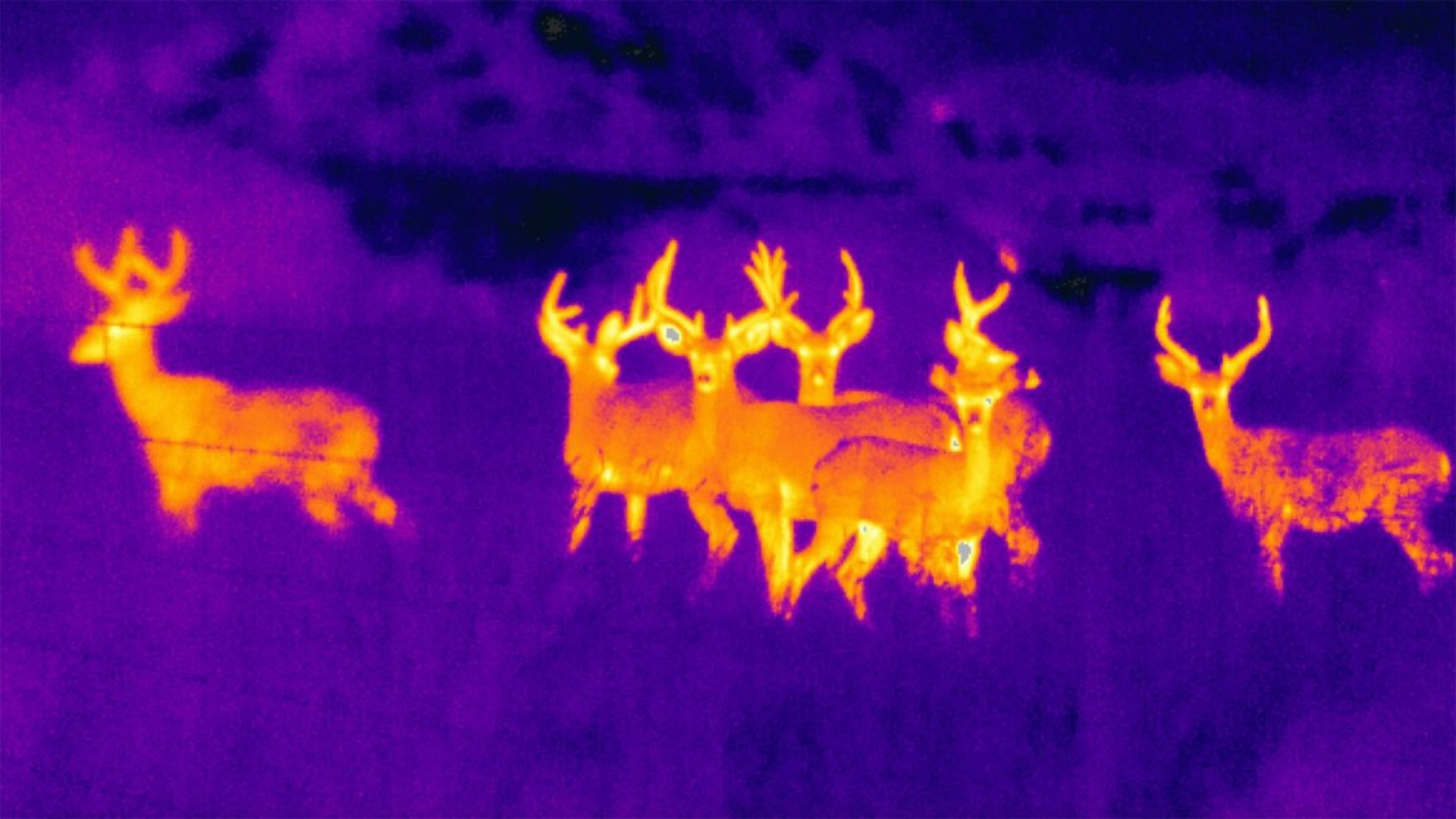
Before spending $500 to $3,000+, you need to understand what thermal imaging actually does — and doesn't — do for hunters. Thermal doesn't see "through" anything. It detects temperature differences and displays them as images. A deer standing in an open field at 3 AM shows up as a bright white (or colored) shape because its 101°F body radiates significantly more heat than the 45°F surrounding terrain.
Here's what determines thermal image quality:
- Sensor resolution: Measured in pixels. 160×120 shows blobs. 384×288 shows definite animal shapes. 640×480 shows details like antler tines. Higher resolution = higher price.
- Pixel pitch: Smaller pixel pitch (12μm vs 17μm) means more detail per pixel. The 12μm sensors in premium devices produce noticeably sharper images.
- NETD (sensitivity): Measured in millikelvins (mK). Lower NETD means the sensor can detect smaller temperature differences. Under 40mK is excellent. Under 25mK is exceptional.
- Refresh rate: 50Hz is smooth; 30Hz is adequate. Below 30Hz, moving animals look choppy and tracking becomes difficult.
- Lens size: Larger lenses (35mm vs 19mm) gather more thermal energy, producing brighter images and longer detection ranges.
Thermal Monoculars vs. Thermal Scopes: Which Do You Need?
This is the first decision you need to make, and it's more important than brand selection:
Thermal Monoculars (Handheld Scanners)
Best for: Scouting, tracking, game recovery, general scanning
A thermal monocular is a handheld viewing device — like thermal binoculars but for one eye. You use it to scan terrain, locate animals, follow blood trails, and scout. You cannot shoot through a monocular. This is the entry point most hunters should start with because it's useful for ALL hunting, not just nighttime predator/hog hunting.
Practical uses that justify the investment:
- Scanning fields and wood edges for deer at dawn before you can see with your eyes
- Locating bedded deer from a distance without walking through bedding areas
- Following wounded game after dark — thermal shows the warm body of a downed animal clearly
- Counting animals in a field to determine herd composition before season
- Detecting coyotes or predators approaching your position
Thermal Weapon Scopes
Best for: Hog hunting, predator hunting, varmint control (where legal)
A thermal scope mounts to your rifle and lets you aim and shoot in complete darkness. These are primarily used for hog hunting (legal at night in most Southern states) and predator hunting. They are NOT legal for big game hunting in most states — check your regulations carefully.
Detailed Thermal Reviews
1. Pulsar Axion 2 XQ35 — Best Thermal Monocular
Price: ~$1,800 | Resolution: 384×288 | Detection: 1,500 yds | Battery: 11 hrs | Weight: 10.9 oz
The Pulsar Axion 2 XQ35 is the thermal monocular against which all others are measured. The 384×288 sensor with 17μm pixel pitch produces crisp images that let you distinguish deer from cattle at 400+ yards. The 35mm lens provides a useful 2x optical magnification with 4x digital zoom — enough to identify animals at practical hunting distances without the bulk of larger-lens units.
What sets the Axion 2 apart is the user experience. It powers on in under 3 seconds (critical when you hear something moving and need to identify it NOW). The built-in photo and video recording captures what you see — invaluable for reviewing deer herd composition or documenting a blood trail for later reference. The Stream Vision 2 app lets you view the thermal image on your phone in real time, which is useful when scouting with a partner.
Battery life at 11 hours is exceptional. I've used this unit on all-night hog hunts, pre-dawn deer scouting missions, and post-shot tracking, and I've never drained a full charge in a single session. The IPX7 waterproof rating means rain is irrelevant, and it's operated reliably at temperatures down to 5°F during late-season hunts.
Pros: Best image quality in class, 11-hour battery, fast startup, built-in recording, WiFi streaming, incredibly rugged
Cons: $1,800 price point, 2x base magnification limits extreme-range ID (use the Axion 2 XQ35 LRF version for rangefinding capability at ~$2,200)
2. AGM Rattler TS35-384 — Best Value Thermal Scope
Price: ~$1,600 | Resolution: 384×288 | Detection: 1,600 yds | Battery: 7 hrs | Weight: 21.5 oz
The AGM Rattler TS35-384 delivers thermal scope performance at a price that undercuts Pulsar and ATN by hundreds of dollars. The 384×288 sensor provides clean, usable images for hog and predator hunting out to practical shooting ranges. The 35mm lens at f/1.0 gathers maximum thermal energy, producing bright images even in cold conditions when temperature contrasts are lower.
Mounted on a .308 hog rifle, the Rattler TS35 performed admirably during several Texas hog hunts. Animals appeared as clear bright shapes against cooler backgrounds, and the 8x digital zoom provided enough detail for confident shot placement at 150-200 yards. The reticle options include multiple patterns, and zeroing is straightforward with the onboard adjustment system.
The main trade-off at this price is build quality — the Rattler feels less premium than the Pulsar Thermion series, and the menu system is less intuitive. But the thermal performance per dollar is the best in this roundup. If you want to start thermal scope hunting without spending $3,000, the Rattler gets you there.
Pros: Excellent value, good 384 sensor, adequate detection range, multiple reticle options, reasonable weight
Cons: Build quality below Pulsar/ATN, less intuitive UI, 7-hour battery (carry a spare), some reports of customer service delays
3. FLIR Scout TK — Best Budget Entry Point
Price: ~$500 | Resolution: 160×120 | Detection: ~300 yds | Battery: 5 hrs | Weight: 6 oz
The FLIR Scout TK is the gateway drug of thermal imaging. At $500, it's the most accessible thermal device on this list, and while its 160×120 resolution won't win any awards, it's genuinely useful for basic game detection, blood trailing, and scouting. Animals appear as obvious warm shapes — you won't count antler points, but you'll know there's a deer in that thicket at 200 yards.
The Scout TK shines as a pocket-sized tool (6 ounces!) that lives in your hunting pack permanently. Need to check if that blob across the field is a deer or a stump? Pull out the Scout TK. Tracking a blood trail after dark? The Scout TK shows you warm blood on leaves far more efficiently than a flashlight. Think of it as a specialized tool for specific situations, not a primary optic.
Pros: $500 entry price, pocketable 6-oz weight, simple operation, 9 color palettes, durable build
Cons: Low 160×120 resolution, limited 300-yard detection, no recording capability, no WiFi
4. ATN ThOR 4 640 — Best Premium Thermal Scope
Price: ~$2,800 | Resolution: 640×480 | Detection: 2,000+ yds | Battery: 18 hrs | Weight: 33 oz
The ATN ThOR 4 640 is a serious thermal weapon scope for serious nighttime hunters. The 640×480 sensor resolution produces images that are visibly sharper and more detailed than 384-class sensors — at 200 yards, you can see individual animal features, not just shapes. The Gen 4 sensor has improved sensitivity and produces cleaner images with less noise, especially in cool conditions.
ATN's smart features set this scope apart: the ballistic calculator adjusts your point of aim for distance and environmental conditions, the Recoil Activated Video records automatically when you fire, and the dual-stream recording captures both video and still images simultaneously. The 18-hour battery life on the internal battery pack is exceptional — most thermal scopes give you 5-8 hours.
At 33 ounces, the ThOR 4 adds significant weight to your rifle. It's not a scope you'll want on a backcountry rifle — this is purpose-built for hog eradication, predator management, and dedicated nighttime hunting setups where you're shooting from a fixed position or vehicle.
Pros: 640 resolution (sharpest images), 18-hour battery, ballistic calculator, recoil-activated recording, WiFi streaming
Cons: Heavy at 33 oz, expensive, complex menu system, significant learning curve, overkill for occasional use
5. Pulsar Thermion 2 XP50 — Best Overall Thermal Scope
Price: ~$3,200 | Resolution: 640×480 | Detection: 2,300 yds | Battery: 8 hrs | Weight: 28 oz
If money is less of a concern and you want the best thermal scope available to civilian hunters, the Pulsar Thermion 2 XP50 is it. The 640×480 sensor with 17μm pixel pitch and <25mK NETD produces images so clear that identifying game species at 500+ yards becomes routine. The picture-in-picture mode lets you maintain wide field of view while simultaneously zooming into a specific target — a feature that changes how you hunt.
The Thermion 2 integrates seamlessly with the Stream Vision 2 ecosystem, allowing firmware updates, live streaming to your phone, and remote zeroing assistance. The 13 electronic reticle options cover every shooting scenario, and the freeze-zoom function lets you zoom in on a frozen image to examine details without the jitter of live digital zoom.
Pros: Best image quality available, picture-in-picture, freeze zoom, excellent build quality, comprehensive reticle library, lighter than ATN ThOR 4
Cons: $3,200 price tag, 8-hour battery (shorter than ATN), significant investment for seasonal use
6. AGM Rattler V2 25-256 — Best Budget Thermal Scope
Price: ~$900 | Resolution: 256×192 | Detection: 1,100 yds | Battery: 6 hrs | Weight: 18 oz
The Rattler V2 25-256 is the most affordable thermal weapon scope that's actually usable for hunting. The 256×192 sensor produces acceptable images for hog and predator shooting at ranges under 150 yards — you'll see animal shapes clearly, though fine details are limited. At $900, it's less than a third the price of premium options, making thermal-equipped hunting accessible to budget-conscious hunters.
For hog hunting in thick Southern brush where shots are typically under 100 yards, the Rattler V2 performs well enough. The 8x digital zoom helps with target identification, though image quality degrades at higher zoom levels. If you're testing whether thermal hunting is for you, the Rattler V2 lets you try it without remortgaging your house.
Pros: $900 entry price for thermal scope, adequate for close-range hog hunting, lightweight, 8x zoom
Cons: Limited 256 resolution, shorter detection range, image quality drops at high zoom, basic feature set
Best Thermal for Each Hunting Scenario
🎯 Quick Recommendations by Use Case
- Deer scouting & game recovery: Pulsar Axion 2 XQ35 — best monocular, works for all hunting
- Budget entry into thermal: FLIR Scout TK — $500 pocket thermal that's genuinely useful
- Dedicated hog hunting (budget): AGM Rattler V2 25-256 — affordable thermal scope
- Serious hog/predator hunting: AGM Rattler TS35-384 — best value thermal scope
- Premium nighttime hunting: Pulsar Thermion 2 XP50 — best image quality available
- Maximum features & battery: ATN ThOR 4 640 — 18-hour battery, smart features galore
🎬 Video Coming Soon
Thermal Imaging for Hunters: What $500 vs $3,000 Actually Looks Like in the Field
Legal Considerations for Thermal Hunting
Thermal imaging legality varies significantly by state and by game species:
- Thermal monoculars (handheld): Legal in all 50 states for scouting and observation. No restrictions on simply looking through a thermal device.
- Thermal weapon scopes for hogs: Legal in most states, especially Texas, Florida, Georgia, Alabama, Louisiana, Oklahoma, and most Southern states where hogs are classified as invasive/nuisance animals.
- Thermal for predator hunting (coyotes, foxes): Legal in many states at night. Some require a specific permit or license for night hunting.
- Thermal for big game (deer, elk): Generally ILLEGAL for active hunting. Most states prohibit any electronic aiming device for big game. The monocular exception is that you can use thermal to scout/observe but cannot use it to aim or direct your shot.
Bottom line: Always verify your state's specific regulations before using thermal for hunting. Regulations change annually, and violation penalties for using prohibited technology can include equipment seizure and license revocation.
Thermal Buying Guide: What Actually Matters
- Start with a monocular: Unless you specifically hunt hogs or predators at night, a thermal monocular is more versatile and useful than a thermal scope for general hunting.
- Resolution matters more than range: A 384 sensor that shows clear images at 200 yards is more useful than a 256 sensor that technically detects at 400 yards but shows blurry shapes.
- Budget at least $1,500 for serious use: Sub-$1,000 thermal works, but the jump in quality from $500 to $1,800 is dramatic. If budget is tight, save for the Pulsar Axion 2 rather than buying a cheap unit you'll replace in a year.
- Battery life is non-negotiable: A thermal that dies at 2 AM during an all-night hog sit is useless. Prioritize units with 8+ hour battery life, and always carry a spare power source.
- Buy from authorized dealers: Thermal optics are a warranty-dependent purchase. Buy from authorized dealers to ensure warranty coverage — gray market thermal optics with no warranty are a risky gamble on a $1,500+ investment.
Get More Gear Guides
Join 10,000+ hunters and get our free Ultimate Gear Checklist plus weekly reviews delivered to your inbox.
Share this guide:
Related Articles
Spring Outdoor Gear Essentials 2026: Fishing, Camping & Turkey Season
Complete spring outdoor gear guide covering coolers, tackle boxes, fishing lures, camping chairs, bug protection, and turkey season essentials. YETI, RTIC, Plano, Thermacell, and more reviewed with prices.
Best Fishing Rod & Reel Combos 2026: Bass, Walleye & Panfish Picks
Expert-tested rod and reel combos from $60 to $500. Shimano, Abu Garcia, St. Croix, Lew's and Daiwa compared. Spinning vs baitcasting, power/action guide, and best combo for every species and technique.
Best Fish Finders for 2026: Sonar, GPS & Live Imaging Compared
Expert-tested fish finder reviews from $200 to $2,000+. Garmin ECHOMAP, Lowrance HOOK, Humminbird HELIX compared. Sonar types explained, GPS mapping, live imaging technology & installation guide for kayak, bass boat & ice fishing.