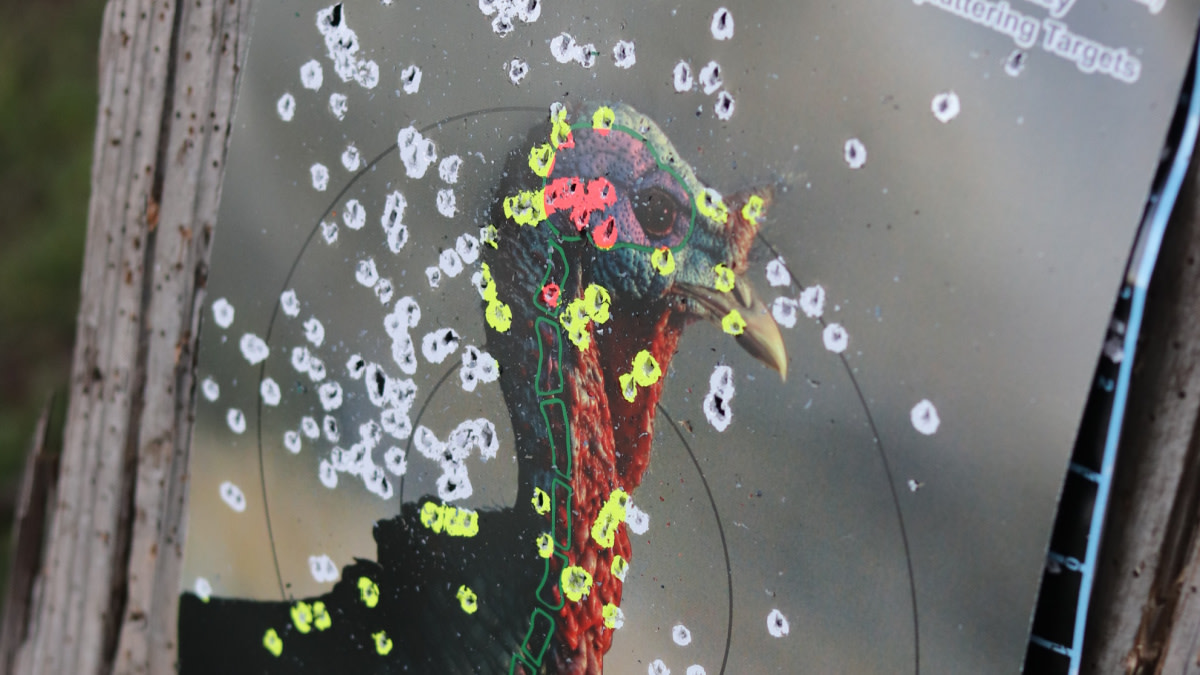
How to Pattern Turkey Loads: Choke & Shell Guide
Affiliate Disclosure: This article contains affiliate links. If you purchase through these links, we may earn a commission at no extra cost to you. This helps support our site and allows us to continue creating in-depth gear reviews. Our recommendations are based on independent testing and research.
Turkey hunting is a shotgun game measured in inches — and the difference between a clean kill and a crippled bird often comes down to how well you've patterned your gun before the season. Most turkey hunters skip this step entirely, assuming any turkey load through any choke will get the job done. After 40+ springs of chasing gobblers, I can tell you: patterning your shotgun is the single highest-return investment of time in turkey hunting.
Why Patterning Matters
A turkey's kill zone is roughly the size of a baseball — the brain and upper spinal cord area of the head and neck. At 40 yards, you need multiple pellets striking this area simultaneously to achieve a clean, ethical kill. A poorly patterned gun might put 300 pellets in a 30-inch circle but leave a 6-inch gap right where the turkey's head is. You'd never know this without patterning.
Every shotgun is different. Two identical guns off the same production line will pattern differently with the same ammunition through the same choke. Barrel harmonics, chamber dimensions, forcing cone geometry, and bore diameter all vary slightly, creating unique pattern characteristics for each individual gun. This is why your buddy's recommendation of "Brand X through a Choke Y" is useful as a starting point but meaningless as a final answer for YOUR gun.
Additionally, the choke-shell combination matters enormously. The best turkey choke with the wrong shell can produce mediocre patterns, and a mediocre choke with the right shell can surprise you. The only way to know what YOUR gun does with a specific combination is to shoot it and count pellets. There are no shortcuts.
What You Need for Patterning
Equipment
- Your turkey gun with the chokes you plan to test
- 3-5 boxes of different turkey loads (we'll discuss which ones below)
- Turkey target paper: These have life-size turkey head/neck outlines with visible aiming points. Birchwood Casey makes excellent ones.
- A solid rest: Bench, sandbags, or a Lead Sled. You want to eliminate human error from the patterning process.
- A measuring tape and a marker
- A notebook to record results (or your phone camera)
- Eye and ear protection: Turkey loads are loud and kick hard
The Shells to Test
Modern turkey ammunition has evolved dramatically. Here are the primary categories and our recommendations for testing:
Tungsten Super Shot (TSS)
TSS has revolutionized turkey hunting. With a density of 18 g/cc (compared to lead's 11.3 g/cc), TSS pellets hit harder at the same size and maintain velocity better at distance. This allows smaller shot sizes (#7, #8, even #9 TSS) that produce dramatically denser patterns while maintaining lethal energy at extended range.
- HEVI-Shot HEVI-XIII ($10-12/shell): The gold standard in TSS turkey loads. Available in #7 and #9 shot. The #7 TSS is our top pick for most turkey guns.
- Federal Premium TSS ($8-10/shell): Federal's entry into pure TSS. Excellent consistency and availability.
- Apex TSS ($6-8/shell): Slightly more affordable TSS option with good performance. Worth testing against the premiums.
Premium Lead/Blended Loads
For hunters who can't justify $10/shell for TSS (understandable — a box of 5 is $50), premium lead and blended loads offer excellent performance:
- Federal Premium 3rd Degree ($5-7/shell): A three-stage payload with Flitestopper #6 lead, copper-plated #5 lead, and #7 HEAVYWEIGHT TSS. Excellent at 20-40 yards.
- Winchester Long Beard XR ($3-4/shell): Shot-Lok resin technology protects pellets during firing, producing tighter patterns than standard lead loads. The best value turkey load on the market.
- Remington Nitro Turkey ($2-3/shell): Traditional copper-plated lead in #4, #5, or #6. The budget option that still performs with the right choke.
The Patterning Process
Step 1: Set Up at 40 Yards
Why 40 yards? Because it's the distance where pattern quality matters most. Inside 30 yards, most turkey loads through any reasonable choke will kill turkeys. Beyond 40 yards, even the best patterns become marginal. 40 yards is where the wheat separates from the chaff.
Pin your turkey target to a backing board at exactly 40 yards (measure it — don't pace it). Set up your gun on a solid rest. You want mechanical accuracy so that any pattern variation is caused by the choke/shell combination, not your shooting.
Step 2: Shoot Three Rounds of Each Combination
One shot doesn't tell you anything — it could be an outlier. Three shots with each choke/shell combination gives you a reliable average. Yes, this means shooting a lot of turkey loads. Yes, they're expensive. Do it anyway. The alternative is discovering your pattern is inadequate when a gobbler is standing at 38 yards and you pull the trigger.
For each combination, record:
- Total pellets in a 10-inch circle centered on the aim point
- Total pellets in the head/neck area of the turkey target
- Pattern evenness — are there gaps or holes larger than 3 inches?
- Point of impact vs. point of aim — does the pattern center where you're aiming?
Step 3: Analyze Results
Here are the benchmarks for a lethal turkey pattern at 40 yards:
Pattern Benchmarks (40 yards)
- Minimum lethal: 100+ pellets in a 10-inch circle (lead #5-6), or 80+ pellets (TSS #7-9)
- Good: 150-200 pellets in 10 inches (lead), 120-160 (TSS)
- Excellent: 200+ pellets in 10 inches (lead), 160+ (TSS)
- Head/neck zone: Minimum 20 pellets in the vital area for clean kills
- No gaps: No holes larger than 3 inches anywhere in the 10-inch circle
Step 4: Test at Multiple Distances
Once you've identified your best choke/shell combination at 40 yards, test at 20, 30, and 50 yards. You need to know:
- At 20 yards: Is the pattern too tight? Some ultra-tight turkey chokes blow a hole through the center of the pattern at close range. If your pattern has a "donut" at 20 yards, you might miss a close bird.
- At 30 yards: This should be your densest, most lethal range. Confirm it.
- At 50 yards: Know your maximum ethical range. If your pattern doesn't meet minimum standards at 50 yards, your maximum is less than 50 yards. Period. Be honest about this.
Choke Selection Guide
Understanding Choke Constriction
Turkey chokes are typically "extra-full" or "super-full" constriction — tighter than a standard full choke. Constriction is measured in thousandths of an inch, and most turkey chokes run .660-.680 bore diameter (for a 12-gauge) compared to .730 for cylinder bore.
Tighter isn't always better. A choke that's too tight for your shell can actually deform pellets, creating blown patterns with a dense ring and a hollow center. This is especially common with large lead pellets (#4-5) through very tight chokes.
Our Recommended Chokes
- Indian Creek Black Diamond Strike ($80-100): Our top pick for most turkey guns. Excellent performance with both lead and TSS loads. Multiple constriction options let you match to your specific barrel.
- Carlson's TSS Turkey Choke ($50-70): Designed specifically for the smaller pellet sizes used in TSS loads. If you shoot TSS exclusively, this is optimized for you.
- Primos Jelly Head Maximum ($30-40): Outstanding value. Competitive patterns with premium loads at a fraction of custom choke prices.
- Factory chokes: Don't dismiss them. Many factory turkey chokes pattern surprisingly well. Always test your factory choke before buying an aftermarket one — you might not need to upgrade.
Common Patterning Mistakes
1. Only Testing at 40 Yards
You need to know your pattern at multiple distances. A choke that's lethal at 40 might blow patterns at 20 (too tight) or 50 (too thin). Test 20, 30, 40, and 50.
2. Testing Too Few Shells
One shot per combination tells you nothing about consistency. Three minimum, five is better. Patterns vary shot-to-shot, and you need to know the average performance, not the best single shot.
3. Ignoring Point of Impact
If your pattern centers 4 inches high and 2 inches right at 40 yards, you'll miss turkeys you aim at perfectly. Check not just pattern density but where the center of the pattern hits relative to your aim point. Add shims to your stock or adjust your optic if POI is off.
4. Chasing Internet Recommendations
"Brand X choke with Shell Y" is someone else's result with their gun. It's a starting point, not your answer. YOUR gun will pattern differently. Trust the paper, not the forum posts.
TSS vs. Lead: The Real-World Difference
Is TSS worth $10/shell? Here's the honest math. In a typical turkey season, you might shoot 2-5 birds. That's $20-50 in ammunition for TSS vs. $6-15 for premium lead. For a $15-35 difference, TSS gives you:
- 10-15 more yards of ethical range
- 30-50% more pellets in the kill zone at 40 yards
- Dramatically better performance with smaller gauges (20ga TSS matches 12ga lead)
- More consistent kill results at the limits of range
For the hunter who shoots a few birds per year, the cost difference is trivial compared to the investment in tags, gear, gas, and time. TSS is worth it. For the hunter who patterns extensively (20-30 shots per patterning session), consider patterning with lead to find your best choke, then confirming with 3-5 rounds of TSS. This saves money on the patterning process.
The Bottom Line
Setting Up Your Patterning Session
A productive patterning session requires planning. Don't show up at the range with one box of shells and hope for the best. Here's how to structure an effective session:
- Bring at least 3 choke tubes: Modified, Improved Modified, and Full (or a specialty turkey choke). Testing multiple chokes with the same shell reveals which combination your barrel prefers — no two shotguns pattern identically.
- Test at least 2 shell types per choke: Different payloads interact differently with each choke. A shell that patterns poorly through a Full choke might shine through an Improved Modified. Buy a box of each shell you want to test.
- Use a solid rest: Eliminate human error by shooting from a stable bench or sandbag rest. You're testing the gun's pattern, not your offhand shooting ability.
- Pattern at multiple distances: Start at 20 yards to verify point-of-aim, then move to 30, 35, and 40 yards. Most turkeys are killed between 20-35 yards, so concentrate your testing in this range.
- Count pellets in a 10-inch circle: Center the 10-inch circle on the densest part of the pattern (not necessarily point of aim — many guns shoot slightly off-center). A lethal turkey pattern puts 100+ pellets from a 2 oz lead load inside a 10-inch circle at 40 yards.
Safety at the Pattern Board
Turkey loads hit hard. Always wear hearing protection (foam plugs at minimum, electronic muffs preferred) and eye protection at the patterning range. Use a recoil pad or shoot from a padded bench — a 3.5-inch magnum turkey load delivers 50+ ft-lbs of recoil, which becomes punishing over a 20-round session. Many experienced hunters develop a flinch during patterning sessions because they skip the recoil pad. A lead sled or shoulder pad reduces felt recoil by 40-50%, keeping your shots consistent and your shoulder functional for the next day's hunt.
Record Keeping
Photograph every pattern board result with your phone. Label each photo with choke type, shell brand, shot size, distance, and pellet count. This creates a permanent record you can reference next season without re-patterning from scratch. Over years, this database shows you exactly which combinations your gun prefers and eliminates redundant testing.
When to Re-Pattern Your Gun
You don't need to re-pattern from scratch every season, but certain changes demand a trip back to the pattern board: switching to a new shell brand or shot size, installing a new choke tube, replacing the stock or adding a recoil pad (which changes cheek weld and point of aim), or any time you notice a miss or poor hit on a turkey that should have been a clean kill. Mechanical changes to the gun always warrant verification. A 10-minute confirmation session with 3-5 rounds ensures nothing has shifted since your last full patterning workout.
Patterning your turkey gun takes one afternoon and a box or two of shells. The knowledge it gives you — exact effective range, point of impact, best choke/shell combination — eliminates guesswork from the most critical moment in turkey hunting: the shot. After 40+ springs, I've never regretted time spent at the pattern board. I've regretted every season I skipped it. Grab your gun, buy some targets, and spend the afternoon. Your next gobbler will thank you.
Recommended Turkey Patterning Gear
Check Price on Amazon →
Check Price on Amazon →
Check Price on Amazon →
Get More Gear Guides
Join 10,000+ hunters and get our free Ultimate Gear Checklist plus weekly reviews delivered to your inbox.
Share this guide:
Related Articles
How to Call Turkeys: Complete Guide for Spring Season
Turkey calling is both art and science. Master the essential calls—yelps, clucks, purrs, and cuts—with this comprehensive guide covering call types, techniques, and real-world hunting strategies for spring gobblers.
How to Field Dress a Deer: Step-by-Step Guide
Proper field dressing preserves meat quality and makes processing easier. This step-by-step guide covers everything from first cuts to cooling, with tips from five decades of deer processing experience.
How to Zero a Rifle Scope: Step-by-Step Guide
A perfectly zeroed rifle scope is the foundation of every ethical shot. This step-by-step guide covers bore sighting, the box test, and field verification so you never miss because of bad zero.